
Book Review: The Green Socialist by Russell Warfield
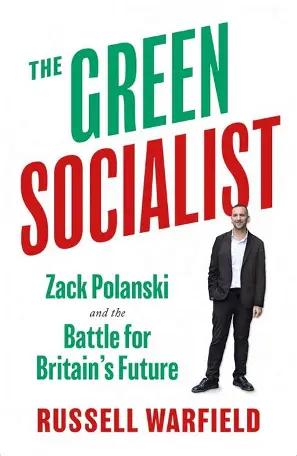
Review of The Green Socialist: Zack Polanski and the Battle for Britain’s Future by Russell Warfield
By Ross Kenny
The Green Socialist: Zack Polanski and the Battle for Britain’s Future dives headfirst into the messy, urgent intersection where climate action meets economic justice.
For anyone on the left who has watched traditional political avenues stall out – especially in the chaotic wake of the Corbyn era – this book offers a fascinating case study.
It tracks the rise of Zack Polanski, the high-profile figure within the Green Party who has leaned heavily into populist-left messaging and disruptive communication tactics.
Warfield uses Polanski’s trajectory as a lens to explore a much larger metamorphosis happening across the British political landscape, asking a critical question: how is modern environmentalism transforming from polite, middle-class moderation into a genuinely confrontational political force?
Warfield frames this political evolution as a direct symptom of the failures of the political establishment. As traditional party loyalty frays and public faith in centrist management completely collapses, a vacuum has opened up.
Radical figures inside alternative parties like the Greens have begun moving into the political terrain that the institutional Labour left once dominated.
The text makes it clear that establishment politics keeps dropping the ball on the most pressing issues of our time, from runaway housing costs and energy poverty to the deepening climate crisis.
This failure creates an opening for alternative frameworks. However, Warfield points out that getting a hearing for those alternatives requires mastering the art of communication. Polanski’s background as a strategist underscores a hard truth for the movement, that even the most brilliant, radical economic policies are essentially dead on arrival if they fail to break through the wall of media noise and emotionally connect with everyday people who are just trying to survive.
Furthermore, the book relentlessly drives home the point that fighting for a livable planet and fighting to redistribute wealth and power are two sides of the exact same coin. You simply cannot have one without the other.
For socialists and radical organisers, this text functions less as a comfortable pat on the back and more as a provocative strategic challenge. There are several vital lessons to unpack from the politics analysed in the pages of Warfield’s book.
Polanski’s Playbook
First, the left must radically change how it speaks to the public. Too often, socialist arguments get bogged down in heavy policy jargon, dry white papers, and defensive moralising.
Polanski’s communication style demonstrates the immense power of framing systemic issues around basic human dignity, legitimate anger at corporate extraction, and a deeply hopeful vision of the future. Socialists need to learn how to speak directly to the things people feel in their gut, such as soaring rent, utility bills, community safety, and economic security, without ever diluting their core structural critique.
Second, the book highlights the importance of seizing institutional openings wherever they appear. Historically, the Green Party has struggled with being pigeonholed as a single-issue pressure group or a lifestyle brand for urban professionals. Yet, the sharp pivot toward an explicit anti-capitalist, eco-socialist platform proves that existing political structures and spaces can be contested and radically repurposed.
Wherever working-class people are looking for a vehicle to express their systemic discontent, militant organisers can step in to shift the entire political horizon.
Third, the politics embodied by figures like Polanski forces a necessary evolution away from the old, productivist models of traditional socialism. By placing ecological collapse at the centre. of economic planning, this book makes it clear that working-class emancipation is fundamentally impossible on a dying planet.
Socialists must champion a future where public ownership guarantees a high quality of life through universal basic services and green infrastructure, rather than chasing endless corporate growth.
Even with its sharp, timely analysis, readers coming from a hard-left or orthodox Marxist background may find certain strategic tensions left unresolved.
Winning elections under Britain’s brutal first-past-the-post electoral system is an uphill battle for any third party, and the book occasionally flirts with the optimistic notion that institutional barriers can be overcome purely through better marketing, sharp rhetoric, and moral clarity. In doing so, it sometimes risks underestimating just how fiercely capital, the media, and the state apparatus will fight to protect private property and elite power when a genuine threat arises.
Ultimately, The Green Socialist is an essential read for anyone invested in the future of progressive and radical politics in the UK.
It steers entirely clear of simple hero-worship, using Polanski’s rise as a diagnostic tool to interrogate movement-building, messaging, and system change. It leaves the modern left with a hard question to chew on – if the traditional roads of social democracy remain blocked, are we brave enough to build new, sprawling coalitions that tie economic survival directly to environmental survival?
For those willing to adapt, learn, and face the polycrisis head-on, Warfield’s book provides a compelling roadmap for the struggles ahead.


Leave a Reply