
South Africa’s Conference of the Left: Rebuilding working-class power beyond fragmentation

by Mazibuko Kanyiso Jara, Member of the Steering
Committee, Conference of the Left
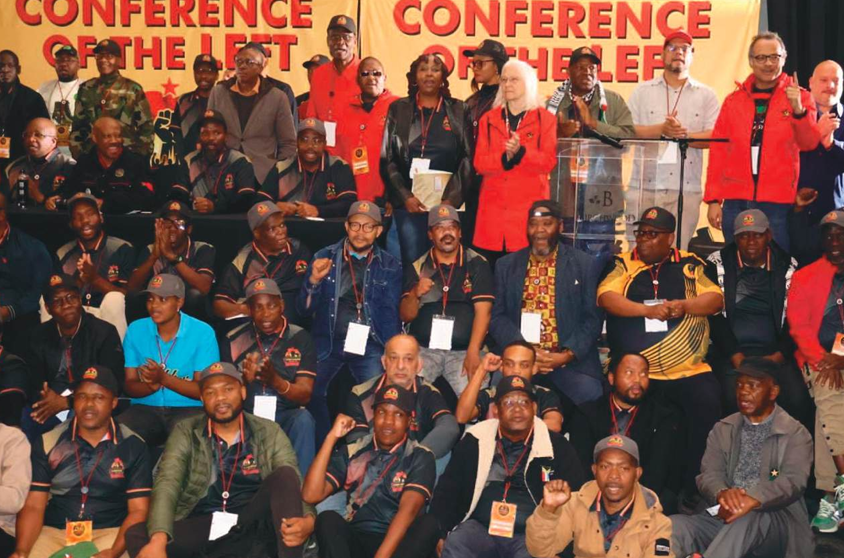
SOUTH AFRICA’S Conference of the Left, held from 29 to 31 May 2026 in Boksburg, was not a festival of easy unity. Nor was it a congress of an already constituted movement. It was something more modest, more difficult and potentially more important: an attempt to bring into one space a fragmented Left, wounded by defeat, divided by history, and yet compelled by the depth of South Africa’s crisis to ask whether it can again become a living force among the working class and the poor.
The conference was convened by the South African Communist Party under the theme “Building a Left Movement for Working-Class and Popular Power.” Its significance lies not in having resolved the crisis of the left, but in having placed that crisis squarely on the table.
It brought together political parties, trade unionists, community movements, civic formations, socialist organisations, youth activists, progressive faith formations, intellectuals and campaigners from different traditions.
Some came from the Congress tradition, some from Black Consciousness, Pan-Africanist, Trotskyist, feminist, cooperatives and solidarity economy movements, ecological, civic and social movement backgrounds. Some have long histories of struggle. Others represent new layers seeking answers in a period of collapsing certainty.
That diversity is not a small matter. In South Africa, the left has often spoken of unity whilst practising suspicion. It has carried historical wounds from the liberation struggle, the negotiated transition, the ANC’s long hegemony, the failures of the Alliance, the collapse of post-apartheid social movements, the NUMSA moment, the United Front, and many smaller attempts at renewal.
The left has also inherited habits of sectarianism: the belief that one organisation already possesses the full truth and that unity means others must dissolve into it. Consequently, there were significant left forces that chose to boycott the Conference. These include the second major trade union federation (SAFTU), the shack-dweller movement (Abahlali baseMjondolo), significant climate justice organisations and some Trotskyist groups. Ostensibly, their critique of the conference was over the participation of the conservative MK Party led by Jacob Zuma and of the SACP’s long-standing alliance with the neo-liberal governing African National Congress.
The Conference of the Left did not proceed on that basis. Its central method was different: unity in action around a common programme, without demanding that participating organisations abandon their identities, histories or organisational homes. This is perhaps one of its most important lessons for comrades elsewhere, including in Scotland and the wider United Kingdom, where the left has also been weakened by fragmentation, mistrust and the gap between electoral initiatives and mass social rootedness.
The immediate context is stark. South Africa’s democratic breakthrough of 1994 defeated apartheid as a political system, but it did not defeat capitalism, land dispossession, racialised property power or structural inequality. The country remains one of the most unequal societies in the world.
Mass unemployment, especially among young people, is not an accident but a structural feature of the post-apartheid accumulation model. The economy remains heavily shaped by mining, finance, concentrated ownership, deindustrialisation and dependence on global markets.
Public services are collapsing in many places. Municipalities are failing. Water, electricity, transport and housing crises have become daily realities for working class communities.
The state itself is in deep crisis. Corruption and tender accumulation have hollowed out institutions. But corruption alone does not explain the problem. Neoliberalism, austerity, outsourcing, commercialisation and the weakening of public capacity have all helped produce the failing state.
The ANC, which once embodied the hopes of national liberation, has presided over this process. It has managed a post apartheid order that incorporated a narrow black elite while leaving the majority of black workers, unemployed people and poor communities trapped in poverty, precarity and social insecurity.
The 2024 election marked a decisive rupture. The ANC lost its parliamentary majority for the first time since 1994 and entered a so-called Government of National Unity.
In reality, this is not a government of national unity in any meaningful popular sense. It is an elite pact to stabilise the political centre while keeping the economic fundamentals intact. It deepens the danger that South Africa’s crisis will be managed through austerity, privatisation, technocratic governance and concessions to capital rather than through democratic transformation from below.
This is the terrain on which the conference took place.
The SACP convened the process because it recognised that the crisis confronting the working class could no longer be addressed through appeals to ANC renewal. The Party has itself been part of the Alliance for decades and must honestly confront its own strategic history. But the conference was not conceived as an SACP recruitment event. Its value lay precisely in opening a broader process in which different left forces could test the possibility of common work.
This was not universally welcomed.
The ANC refused to attend and characterised the conference as a “coalition of negation.” That criticism misses the point.
To oppose neoliberalism, corruption, austerity, privatisation, xenophobia and the Government of National Unity is not to be merely negative. It is to recognise that no credible Left can be built by continuing to subordinate itself to a governing party that has failed to transform society.
But the conference also had to guard against another danger: imagining that the ANC’s decline automatically benefits the left. It does not.
The collapse of ANC hegemony has opened space for liberalism, ethnic nationalism, right-wing populism, xenophobia, religious conservatism, gangster politics, local warlordism and authoritarian solutions. The working class is angry, but anger has no guaranteed progressive direction. If the left does not organise, others will organise that anger.
This is why the conference’s emphasis on programme was important.
It declared that the left must move beyond critique and begin constructing a credible alternative economic plan. That plan must address fiscal policy, monetary policy, industrial policy, trade, public investment, ownership and control of strategic sectors, developmental finance, democratic planning, employment, public services and social ownership. These are not abstract policy questions. They are questions of class power.
South Africa cannot be transformed by moral appeals to better governance alone.
The structure of ownership must be confronted.
The financial system must be subordinated to developmental and social priorities. Strategic sectors must be brought under forms of public, social and democratic control. Land reform must move beyond endless delay. Municipalities must be rebuilt as sites of democratic planning and service delivery, not as feeding grounds for tenders. Industrial policy must create decent work, not merely incentives for capital.
The ecological crisis must be addressed through a just transition led by workers and communities, not by green capitalism.
The conference also affirmed the need for working-class and popular power. This formulation is important. The working class in South Africa today cannot be imagined only as organised industrial workers in large workplaces. It includes mineworkers, metalworkers, farmworkers, public-sector workers and retail workers. But it also includes the unemployed, precarious workers, informal workers, migrant workers, care workers, township youth, rural communities, women sustaining households through unpaid labour, and millions surviving through grants, debt and informal livelihoods. A renewed left must organise across production and social reproduction.
It must connect the workplace to the township, the mine to the municipality, the union to the community, and the struggle for wages to the struggle for water, electricity, housing, food, safety and dignity.
This is not easy. Trade unions have been weakened. Community organisations are fragmented. Youth politics is often episodic. NGOs sometimes substitute for movements. Left parties and formations remain small.
Social media has become a major political terrain, but progressive forces have not yet mastered it as an organising space.
Meanwhile, reactionary forces mobilise popular anger through xenophobia, anti-migrant scapegoating, attacks on NGOs and simplistic solutions to complex crises.
The conference therefore resolved to establish a Council of the Left. This is not intended to be a new political party, nor an electoral machine. Its purpose is to coordinate action among different formations around campaigns, political education, programme development and mass mobilisation. It is a mechanism for common work, not a substitute for the organisations that already exist.
This is both promising and fragile.
A council can become a living instrument only if it is rooted in real struggles. If it becomes merely another meeting of leaders, it will fail. If it becomes a battle field for organisational manoeuvring, it will fail. If it allows the strongest forces to dominate and the smallest to decorate the platform, it will fail.
But if it helps build campaigns, train activists, coordinate solidarity, produce popular education materials, develop a common programme and connect local struggles nationally, it can matter.
The first tasks should be concrete. South Africa faces a local government crisis that affects every working-class household. A left programme of action should organise around water, electricity, sanitation, housing, transport, municipal corruption, land use, public employment and the rebuilding of public capacity.
It should defend migrants and build working-class unity against xenophobia. It should support workers resisting retrenchments and casualisation. It should organise around food sovereignty, climate justice, public ownership, care work and youth unemployment. It should build political education that speaks plainly to people’s lives.
The left must also recover the internationalist tradition of South African struggle. The anti-apartheid movement was never national in a narrow sense. It was nourished by African liberation, socialist internationalism, trade union solidarity and global anti-imperialist networks.
Today South Africa must again locate its struggle within the wider fight against imperialism, debt, militarism, sanctions, ecological destruction and the power of global capital. But internationalism must begin at home by rejecting xenophobia and defending African working-class unity.
There has already been criticism of the Conference of the Left. Some of it is useful.
The left does need rebuilding, not merely unity from above. It does need new social roots, not only declarations. It does need to confront the weakness of existing organisations, not hide behind nostalgia.
But criticism that dismisses the conference as hollow misses the seriousness of the moment. A fragmented left cannot be rebuilt without spaces of encounter, argument and common planning. The conference was one such space. It should be judged not as a finished product, but as an opening.
The great danger is to mistake a beginning for an achievement. The great opportunity is to turn this beginning into a process.
For comrades in Scotland and elsewhere, the South African experience offers no model to copy. But it does suggest a problem we share: how can socialist forces move from fragmentation to unity in action without pretending that differences do not exist?
How can a common programme be built without forcing premature organisational unity? How can electoral work be connected to mass organising rather than replacing it? How can the working class become not only an object of sympathy, but the organiser of a new historical project?
These are not South African questions only. They are questions for a world in which neoliberalism has failed but still governs; in which the far right grows by feeding on despair; in which social democracy has been hollowed out; and in which the organised working class must rediscover its capacity to lead.
The Conference of the Left was not the answer. It was a call to begin answering. Its test will be whether, in the months ahead, it helps workers and communities fight, organise, learn and build together.
The South African left has spent too long explaining defeat. It must now organise hope — not as sentiment, but as disciplined collective power


Leave a comment