
Ravenscraig, Data Centres and the UK Steel Industry
By Colin Fox, SSP National Co-Spokesperson
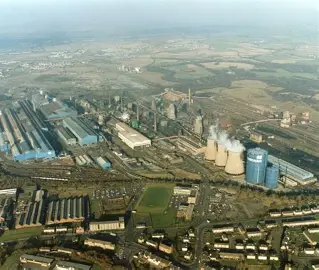
I was born in Craigneuk, Wishaw under the shadow of the giant Ravenscraig steelworks. And I remember as a child how my mother would often have to take the washing in off the line after it was covered in the red dust pumped out of the nearby cooling towers.
Our wee council house in Charles Street today sits alongside a new edifice, the bonnie statue erected to commemorate local ‘Lisbon Lion’ Tommy Gemmell.
On a scroll through ‘YouTube’ this week my attention was drawn to a video outlining an application in front of North Lanarkshire Council to build a 55megawatt data centre on the site of the former steelworks. In it Ben Benford from Apatura Energy argues the new facility would harness much of the renewable wind energy unused by the national grid nowadays.
The ‘wind curtailment charges’ [cost to the national grid of excess energy generated by wind turbines] seemed a rather curious reason for the AI project I thought.
What about the benefits to the local community/economy? And who should benefit from these huge data centres and the lucrative profits to be made? This reincarnation of Ravenscraig made me question why the new technology is not publicly owned as the steelworks were?
Scunthorpe
To say the steel industry in Britain today is a shadow of its former self is to miss-describe the word shadow. ‘British Steel’ has a single plant at Scunthorpe whose jobs have been in jeopardy for quite some time.
The Chinese firm Jingye bought it out of insolvency in 2020 after its previous owners could not make a go of it. But Jingye soon faced the same difficulty as the blast furnace is old and inefficient. The cost of making steel there is prohibitive compared to elsewhere in the world.
To make matters worse the days of blast furnaces making high quality ‘virgin’ steel are over as ‘electric arc furnaces’, like the ones being built at Port Talbot in South Wales, do so more cheaply.
Electric arc furnaces use recycled steel to make new products.
Jingye opened negotiations with the UK government to share the £1bn cost of installing electric arc furnaces at Scunthorpe, but the negotiations broke down amid acrimony on both sides. The government accused the new owners of planning to close the factory with the loss of four thousand jobs.
The UK government nationalised the plant to halt the closure threat. But that is no solution long term. The taxpayer is now ‘on the hook’ for losses of £500m-£1bn/year as there is worldwide overcapacity in steelmaking. To add insult to injury Jingye has sued the government for £500m in compensation.
Bigger questions are posed in relation to this situation too. Why, for instance, do governments nationalise only loss-making industries, never profitable ones?
I prefer to call it ‘public ownership’ because ‘nationalisation’ is a term that has been discredited by years of failure. Labour always aims to sell off such state assets to the private sector as soon as they can. The Royal Bank of Scotland [RBS] being a famous case in point.
Labour MPs offered up several spurious arguments to defend their decision on Scunthorpe; that the UK needs a steel-making industry as vital part of a modern economy. But that pass was sold 40 years ago when Ravenscraig and plants across the UK were sacrificed on the altar of globalisation.
That UK defence industries need UK steel as a matter of national security, imports will not do. Yet it is a long time since the warships on the Clyde, or the submarines at Barrow, or the tanks and aircraft manufactured across the UK exclusively used British steel.
The Queensferry Crossing was, as people will recall, built using imported Chinese steel. That Britain must retain the capacity to make ‘virgin steel’ using the imported raw ingredients like iron ore and coking coal rather than recycled materials. This is also nonsense as most countries across the world are investing in electric arc furnaces.
Labour ‘Nationalises losses and privatises profit’
The UK taxpayer is losing £1bn/year at Scunthorpe at a time when Chancellor John Healey is said to be considering tax rises and welfare cuts. Labour’s decision to nationalise Scunthorpe was clearly all about party politics.
They feared Reform in 2025, who had a strong presence in Lincolnshire following the Brexit/EU referendum. But with Reform now sliding down the polls, I expect Labour to revisit its decision.
Their ‘saving steelworkers jobs’ promise was a cruel deceit. The fact is British capitalism abandoned volume steelmaking when it closed Ravenscraig 40 years ago.
I can see Healey pulling the plug on Scunthorpe now that Reform UK has ‘shot its bolt’. Labour has never supported the concept of public ownership as a long term solution to anything, and few expect it to do so much longer at Scunthorpe.


Leave a comment