
The Events in Ireland: Working Class Unity and Socialism to Combat Racism
By Richie Venton (who grew up in County Fermanagh)
In early June, Belfast witnessed the worst street violence in decades. Gangs of black-clad boys and men, in masks and balaclavas, rampaged the streets, in an orgy of racist attacks.
Immigrants and people of colour, some of whom were born and reared in the city, were burnt out of their houses. They were targeted, their homes bricked, firebombed and invaded, amidst shouts of “where are the immigrants?” and racist obscenities including “black bastards”.
At least 200 have been terrorised out of their homes, after living as good neighbours, in many cases for years. The victims of what can only be described as a racist pogrom include families with young children; one of those escorted into a police wagon, fleeing their home, was a two-months-old baby.
Cars and buses were torched, bus drivers assaulted, businesses burnt down, including the shop of a black man who’d lived harmoniously in the Shankill Road for nearly 30 years. The same gangs set up roadblocks and demanded ID checks from black health workers and others as they went to care for people in the local hospital.
Thankfully, nobody was killed, but immigrants and people of colour were terrorized and permanently traumatised in scenes reminiscent of the worst sectarian upheaval and violence during the 30 years of the so-called Troubles.
Echoes of 1969
For older locals, it dredged up memories of the sectarian pogroms in 1969, including Belfast’s Bombay Street; a summer when thousands of Catholics and smaller numbers of Protestants were firebombed or intimidated out of their homes, forced into what at the time was the biggest displacement of populations in western Europe since World War Two, breaking down the integrated housing of the 1960s, increasingly segregating and dividing the working class.
Relatively small numbers took part in the racist riots, a few hundred overall, but others treated it as a spectator sport, watching from the sidelines.
Roots of the riots?
The question is, what led to this, what are the roots of it, and what are the potential solutions to prevent its future repetition?
The immediate trigger was the hideous, murderous knife attack on Stephen Ogilvy in North Belfast. Carried out by a man from Sudan, who had been given legal right to remain in N Ireland until 2028 by former Tory Home Secretary, Suella Braverman, ironically a subsequent defector to the anti-immigrant, far-right Reform UK!
Nobody would defend this appalling stabbing, which only the intervention of a local man with his son’s hurley stick prevented becoming a murder. But it was used as a cynical excuse for pre-planned attacks on people with absolutely nothing to do with this violent crime – mob violence
against innocent, decent people simply because they have a similar skin colour to the perpetrator of this inexcusable crime.
White crimes don’t count for the far right
If it was anything other than a racist mobilisation, orchestrated by far-right forces, why has there been no similar street mobilisations when white men (or occasionally white women) carry out an actual or attempted beheading of their victims? There have been several cases in the past couple of years in towns including Bristol – where a neo-Nazi woman, Alina Burns, tried to decapitate a Kurdish barber – and London, Newcastle, Gateshead.
Nor have these racist forces – and the sinister puppet-masters pulling their strings – responded with peaceful protests, let alone street riots, when women in Northern Ireland have been murdered by their (white) partners or people who knew them well.
Since 2020, 30 women have been murdered in the North by men intimately known to them, and there have been 67 such victims of misogynistic murder across Ireland, North and South, in the same period. Murders not at the hands of immigrants, but of violent white men.
Sinister puppet-masters
The murderous stabbing was used as a cynical excuse to incite racist violence – contrary to the explicit public appeal by Stephen Ogilvy’s family.
Grant Calder, one of the Reform UK activists who campaigned for Glasgow’s Reform UK MSP, Thomas Kerr, boasted in advance on Facebook that there was going to be “trouble in Belfast”, with migrants “getting put out of houses and hotels”, hours before the riots started.
Trillionaire Elon Musk last year predicted that Britain was “inevitably facing civil war” and proceeded to try to fulfil his own prophecy, vastly boosting the circulation of far-right posts from a couple of hundred to millions, and sharing the calls of Tommy Robinson – from the safe distance of Russia, where Robinson was meeting Musk’s South African father at the time – to respond to the assault on Stephen Ogilvy with street protests and barricades.
All these ‘actors’ circulated posters with lists of exact street corners and times to meet and set up barricades, demanding businesses and schools shut down.
Days before, Nigel Farage had called for “pure, cold rage” after the death of Henry Nowack in Southampton.
Local right-wing loyalist politicians such as Jim Allister of Traditional Unionist Voice (TUV) spoke of the “importation of alien cultures”. He didn’t let the truth that a mere 3.4% of the N Ireland population are immigrants get in the way of his scaremongering, racist incitement.
These are the forces with blood on their hands, the real instigators of the racist pogroms: thugs in suits who won’t be anywhere near the young rioters when they face criminal charges that will mark them for life and further drive them into poverty and alienation.
PSNI were warned of racist hitlists
Since last August, a group of volunteers called Accountability Project Northern Ireland have been monitoring far-right activity – in the aftermath of the racist terror in Ballymena in June 2025.
Since then, they’ve sent at least 50 separate reports to the Police Service Northern Ireland (PSNI) warning them of anti-migrant activity online, in far right and fascist circles, with threats of attacks on ethnic minorities. Several times since January – including the week before the June riots – they alerted the PSNI that far-right groups were circulating the addresses of migrants in Belfast, Newtownabbey and elsewhere. The PSNI chose to ignore their warnings. Many of the addresses subsequently firebombed and terrorised were on those same hitlists.
The state forces failed to protect people from the terror gangs, and indeed when the riots erupted, many people in Belfast, Derry, Portadown, and other towns said the PSNI were “nowhere to be seen”. A reminder that working-class communities cannot put their faith in the state to protect them; it requires united action by working-class people.
Alienated, poor teenagers egged on by paramilitaries
Most of the rioters were in their teens, with cases reported of rioters as young as 10. But older heads were guiding them, or as a minimum standing back and doing nothing to stop them in their racist assaults.
Belfast journalist Sam McBride attended one of the areas where about a dozen masked-up youth set up roadblocks, paramilitary-style checkpoints, where he was assaulted when he politely asked them to say why they were doing so, and where UVF veterans known to him were among the bystanders.
In fact, the rioting occurred overwhelmingly in areas of multiple deprivation, home to the very poorest working-class Protestants, where the paramilitaries of the Troubles period still exist, mostly preoccupied with the lucrative business of drug-dealing and intimidation of residents. Irish news outlets have identified cases of young people being obliged to join the riots to settle a £500 drugs debt.
The degree to which paramilitaries were directing operations is hazy and disputed, but as a minimum they did nothing to quell the racist attacks. These riots would not have been allowed to go ahead without at least their say-so or acquiescence. They control much of the areas through a mixture of intimidation and the attraction they hold for a small minority of desperately poor and alienated young men in particular, who have no lived memory of the Troubles and the role of these sectarian death squads.
Social roots of racism
The roots of the riots lie deep in the social disintegration of a capitalist statelet.
The institutions and politicians of the 28-year-old Good Friday Agreement (GFA) have failed utterly to root out the poverty, inequality and collapse of housing, NHS and other social services which people depend on for their daily life.
Wages are lower in the North than for the same jobs in Britain – as has been the case throughout the century of Northern Ireland’s existence.
The NHS is in a state of even more severe crisis than here, with thousands waiting for appointments, treatment and operations, sometimes with fatal or near fatal consequences, as I know from direct family experiences.
51% of those on NHS waiting lists have been there for over 52 weeks. And of course, the situation in healthcare would plummet into absolute collapse if it wasn’t for the efforts of immigrant workers.
Housing has always been a source of misery. Recently, the numbers languishing on the housing waiting lists exceeded the landmark 50,000. The Housing Executive has only built – at most – 18,000 homes in the 28 years since the Good Friday Agreement (GFA) was signed.
Amidst all the fanfares surrounding the GFA and establishment of the Power-sharing Executive, promises were trumpeted of “a peace dividend”. The people of all working-class communities were to enjoy a land of milk and honey, with an inflow of jobs, investment, boosted services, and more. That dream was always a cruel deceit.
‘Peace’ – but no ‘peace dividend’
The relative peace is hugely welcomed after the deaths of over 3,500 people during the Troubles, but plentifulness has certainly not trickled down to working-class communities.
A layer of politicians – unionist and nationalist – have done very well out of it, but they’ve failed the communities who elected them. They’ve passed on Westminster cuts, and haven’t even managed to agree a budget currently, which adds to the job losses and service cuts.
Particularly since the 1960s, the Catholic population have rightly refused to accept the status of second-class citizens, facing brutal discrimination on jobs, housing and services, and a dose of vicious state repression. But the well-heeled politicians voted into office, mostly on a sectarian headcount under the GFA, are incapable of cutting across the growing siege mentality amidst poverty in the most deprived Protestant districts.
A sort of triumphalist nationalism from Sinn Fein has done nothing to counter the fears whipped up in those communities by sectarian loyalist bigots, including ones elected to well-heeled jobs as Members of the Local Assembly in the same sectarian headcount.
Racism North and South
Far-right forces – none of them suffering anything like deprivation! – threw the torch of racist anti-migrant lies into this tinderbox of poverty, alienation, despair and ‘siege mentality’.
And it should be registered in passing, whilst the Belfast riots were almost exclusively in deprived Protestant districts, racism does not respect denominational boundaries.
Racist slogans appeared on West Belfast and Derry walls at the same time, and an obnoxious case of prolonged racist harassment of a black lad in Ardoyne was videoed and widely circulated.
Most significantly, the same capitalist crisis, and utter failure of the mainstream capitalist parties to tackle the social malaise, has fuelled vicious racist and xenophobic gatherings in the South, with several far-right racist councillors elected, and attempts to burn down asylum seeker hostels by thugs draped in the Irish tricolour.
Indeed, after the 2024 Southport riots, we had the spectacle of racist loyalists and racist nationalists joining forces, with Union Flags and Tricolours aloft, in a grisly embrace across the sectarian divide at riotous demonstrations in Belfast and in the South.
What is to be done?
The question is, what to do about it?
Events in response to the June riots are a harbinger of a better future.
It wasn’t the state forces, including the PSNI police force, which put up the best response. It was working-class people, individuals and groups on the ground. Community groups. Volunteers. Women’s organizations. Trade unionists. Anti-racists. Socialists. Ordinary, decent people acting as good neighbours. There were many incidents of them rescuing people from their burning homes, taking them to safety by car, feeding people made homeless, giving them shelter in their own homes or in community centres.
Groups of volunteers visited immigrants to reassure them they were welcome, to help protect them.
Trade unionists united
African health workers were chased and intimidated as they went into their workplace, including Belfast’s Royal Victoria Hospital. In response, the trade unions organised a joint rally at the hospital, uniting members of NIPSA, UNITE, RCN and UNISON, warning off the racist bigots.
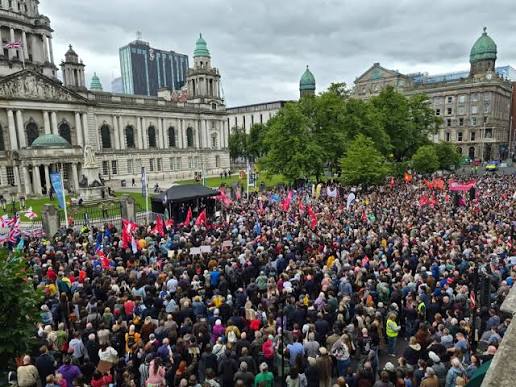
The Saturday after the days of racist attacks, a massive rally under the banner Unite Against Hate was held outside Belfast City Hall. The biggest anti-racist rally in Belfast history. Estimates ranging from 10,000 to 20,000 gathered in outrage at racism, with the full support of the entire trade union movement, heavily populated by banners and speakers from a range of unions and socialists. Thousands gathered simultaneously in Derry, (and Glasgow!) and the next day in Dublin.
They were determined to stop any return to the days when trade unionists were amongst those intimidated or murdered by paramilitaries during the Troubles, when it was strikes and rallies by Catholic and Protestant workers united which prevented the spiral into all-out civil war.
Trade unions hold the key
The trade union movement has a key role to play in countering not just racism, but the roots of its proliferation.
Over 200,000 workers are in unions in the North – and about 550,000 in the South. They embrace workers of all creeds and colours, Protestant and Catholic, immigrants and Irish-born, black and white, men and women.
Alongside and since the week of the June riots, workers have been united on picket lines at several strikes, including a sawmill in Enniskillen and factory in Newry.
That’s the force which has an opportunity and duty to lead a struggle to build working-class unity and socialism in Ireland.
For workers’ unity and a socialist Ireland
Rather than let the sectarian or tribal capitalist and pro-capitalist politicians dominate, the trade union movement needs to spearhead a struggle for socialist measures like taxation of the rich; an immediate £15-an-hour minimum wage, rising with inflation; expansion of community services and facilities, for people of all ages; massive social house-building for affordable rent; investment and expansion of the NHS, education and public transport; in a nutshell the harnessing of wealth for the common good, not the profits of the few.
As Karl Marx once said, sometimes the revolution needs the whip of counter-revolution. The unity of workers and young people on display since the racist pogroms in June is where hope for the future lies. For working-class unity and socialism, a socialist Ireland where there can be plenty for all, regardless of denomination, colour or country of birth.


Leave a comment