
Save Our Fire and Rescue Service
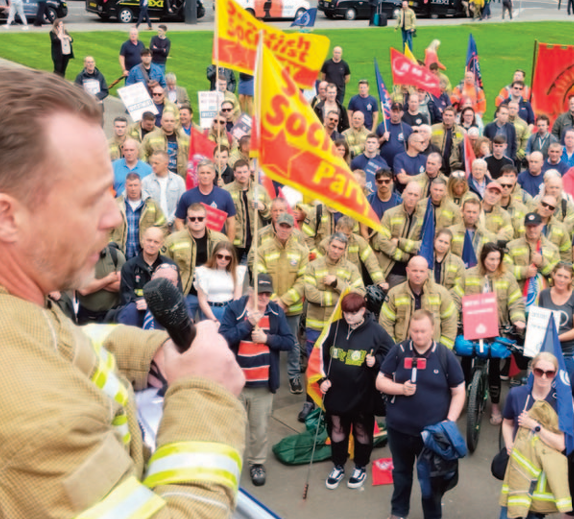
by Colin Brown, FBU NEC member for Scotland
AS WE HEAD INTO STUC congress #26, the pressures being faced across the entire public sector are once again laid bare for all to see. From violence in schools not being treated as the serious multi-generational issue it should be, to cuts across every sector.
For firefighters, these cuts continue unabated, not just in Scotland but across the UK. Failure by successive Scottish and UK governments have put firefighters on an industrial action footing in multiple Fire and Rescue Services across the UK.
Decisions on 23 proposed change options that have the potential to close fire stations, remove fire engines and reduce overnight and weekend fire cover in communities across Scotland, have been delayed until after the result of the 7 May Scottish Parliament election.
The need for continued, relentless campaigning to defend our fire service must also continue unabated; the risks to firefighters and the communities we live and work in are too great for us to pause now.
Glasgow’s big fire
At the beginning of March, Scotland, and specifically Glasgow, was shaken by the loss of another historic building to fire. The tinderbox city once again seeing first-hand the unrelenting, destructive ferocity of fire.
It was firefighters in Scotland’s critically understaffed control rooms that answered the calls from the public, mobilised firefighters, and managed the command and control of the incident, involving 18 fire appliances and specialist resources — including high reach appliances, one of which had to mobilise from Edinburgh’s MacDonald Road, involving a blue light journey of some 51 miles.
It was 200 firefighters that responded to the incident over the course of multiple days that stopped that fire in place, preventing the catastrophic loss of the Central Hotel and Scotland’s busiest rail station.
The overwhelming majority of those firefighters are FBU members, who daily are sent to fight fire, rescue, and save life and property, whilst facing the dual fight for their jobs, their safety and the safety of their communities, following decades of underfunding by successive UK and Scottish Governments.
Swinney’s praise… & cuts
There is a brutal and depressing irony that at the time the First Minister visited the incident on Glasgow’s Union Street, commending Scotland’s firefighters and rightly announcing support for those that had lost their livelihoods as a result of the fire, FBU officials were meeting civil servants to be briefed on budget papers that propose public sector headcount reductions of 2.5%, and flat cash budgets until 2029/30, as part of a “managed reduction” of Scotland’s public sector workforce.
To put the impact of funding cuts of this scale in perspective, this would equate to over 500 full-time firefighter posts being cut on top of the 1,200 already lost in the last 13 years.
‘Worse cuts outside Scotland’ is no excuse Previous Government Ministers, MSPs and now prospective parliamentary candidates have been quick to attempt to counter FBU demands for an end to the ongoing austerity-driven cuts with statements that “Scotland maintains a higher number of firefighters per head of
population than other parts of the UK.” Repeated FBU requests for evidence to support this claim have not been answered.
Even if there is any truth to these claims, what is not considered, or certainly not presented, is the reality for firefighters in those other parts of the UK who, following years of even more savage funding cuts to Fire and Rescue budgets, are routinely forced to work with unsafe crewing on the back of fire engines. At times mobilising with just three firefighters and in some instances proposals to mobilise with just two.
For perspective, it’s worth briefly describing that firefighters do on arrival at a fire and why the FBU demand safe crewing levels of 5 on fire engines.
On arrival, the Incident Commander will undertake a rapid assessment of the scene, form an initial attack plan and deploy their crew.
Demand five to a fire engine
Two firefighters will form the firefighting team, donning breathing apparatus (BA) and entering with a line of hose to attack the fire and rescue trapped persons.
Outside there must be a safety officer who monitors the safety of the BA team. The fifth crew member, having driven to the incident, will be securing a water supply, usually from a street hydrant, passing messages from the incident ground to fire control, setting up safety cordons, and assisting the incident commander.
All these tasks happen in the first minutes of arriving at a fire. Removing one of those firefighters means these safety critical tasks are significantly slowed; removing two means the firefighting (BA) team can’t be deployed until further firefighters arrive on scene.
Matter of life & death
Whilst the wait for additional firefighters to arrive is excruciating for those first to arrive, imagine the agony of being trapped in a burning room awaiting rescue where every second really does count and delays are the difference between life and death.
Like most Health and Safety protections, the safe crewing model of five firefighters on a fire engine was fought for and won following tragic losses, injury, and death of firefighters and members of the public.
Those attempting to justify continued cuts to Scotland’s Fire and Rescue Service by looking to other countries and claiming at least we’re better than them, really need to understand just how dangerous the cuts they are replicating have been for firefighters and communities in other parts of the UK before flippantly casting aside concerns that are literally about life and death.
Party election manifestos
At the time of writing, Scotland’s political parties have just published their manifesto’s ahead of the 7 May Scottish Parliament elections. It has been encouraging to see that almost all have included pledges to protect and improve Scotland’s fire service.
The SSP have, as always, been the most vocal in their support of the demands of Scotland’s firefighters.
Whoever forms the next Government must be held to their pledges, and to be made to go beyond their own party pledges if they genuinely believe in the safety and wellbeing of the communities and constituents they want to represent.
 Scottish Socialist Voice
Leave a comment