
Are Smartphones Such a Clever Idea in Schools?
by Voice special correspondent
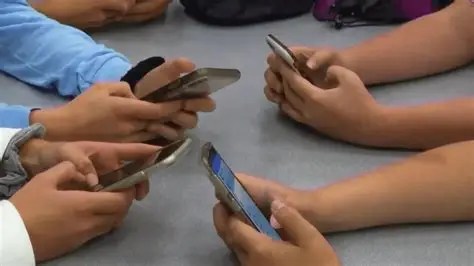
THE USE OF MOBILE PHONES in schools has been a contentious issue for a number of years.
With the introduction of smartphones and their ever-increasing functionality to incorporate every aspect of daily life, from answering your front door when not at home to paying for a school dinner, the use and access of phones in school by pupils has become an increasingly challenging and multifaceted issue where there is no clear or definite answer. To suggest there is a simple answer to such a complex issue would be disingenuous.
We need to acknowledge how deeply embedded mobile phone use is throughout society. How would you feel about arriving at work for the day and having your phone confiscated? What level of anxiety would that cause you?
Equally, how would you feel about being in a workplace or learning environment with over 1,000 people, virtually all of whom have a high-powered camera and video at their fingertips, able to capture your every move, the software to create a video or meme within minutes, and the ability for that to go viral within the school community and more widely within a matter of minutes? How would you feel as a parent who is unable to contact your child for eight hours a day when they may have complex medical needs or know they are being bullied at school? Whichever way you approach this issue there is no one-size-fits-all answer which suits everyone and provides a simple resolution.
There is also the issue of utilising the technology and learning opportunities that phones can provide when used properly during a time of ongoing underfunding of resources in schools and the issues around trying to poverty-proof the school day. Does allowing the use of mobile phones in schools as learning resources simply further reinforce disadvantage amongst poorer pupils and families?
Finally, there is the issue of whether mobile phones are the issue or whether poor policies, practices and cultures around behaviour and violence in school are the fundamental underlying issue, with mobile phone use or misuse simply reflecting and amplifying the culture within a school.
When mobile phone misuse takes place pupils know very quickly the response that the school has taken to the matter and whether genuine steps have been taken to address the behaviour or whether a tokenistic restorative conversation is the sum total of the action taken. These messages matter. Recent weeks have seen two major developments.
One of the teaching unions, the NASUWT, has taken the strongest position to date, calling for the prohibition of mobile phone use in schools, whilst research from the University of Birmingham has set out what a complex and resource-draining issue mobile phones are, whatever position you take on it.
The NASUWT position follows a landmark case in Northern Ireland where a teacher was persistently upskirted by a pupil and the school not only failed to address the pupil’s behaviour but rewarded them by making them a prefect. This led to a change in the law in November 2023 in Northern Ireland, with upskirting becoming a specific criminal offence.
As the largest teaching union in Scotland, the EIS appears to lack a clear up-to-date position that is readily available, with its website still showing a policy position from 2007. The SSTA carried out a detailed survey amongst its members in 2024 which clearly set out the issues: “92% of members said their lessons were being interrupted by asking pupils to put away their mobile phones. 13% of members said half their lessons were interrupted but more worryingly 75% said the majority to all their lessons were interrupted.”
When members were asked about their concerns regarding the inappropriate use of mobile phones during lessons, members said:
• 90% pupils have detachment issues;
• 90% texting during lessons;
• 80% taking photos;
• 60% social media bullying;
• 46% answering calls during lessons;
• 41% viewing inappropriate content;
• 35% live recording of lessons (audibly, visually, or both).
The Scottish Government released guidance in August 2024 which essentially left decision-making to individual local authorities and schools.
So, what does the evidence tell us? The recently published University of Birmingham research involved 20 secondary schools in England of roughly 1,000 pupils per school.
It analysed data collected from 815 students and staff from a nationally representative sample of 20 UK schools (13 with restrictive policies, seven permissive) on the economic implications of school smartphone policies. The study is the first analysis of nationally representative data from schools on the economic impact of different smartphone policies.
Self-reported data suggests that on average, schools with restrictive policies spend 102 hours, or the full-time equivalent of 3.1 staff, per week overall on implementing policies. Schools with permissive policies spend slightly more time on average (108 hours, or the full-time equivalent of 3.3 staff per week).
So, whatever approach a school takes, managing mobile phone use either throughout the school day or through some form of phone storage system is equally time- and resource-heavy.
According to the report: “In schools with restrictive policies, staff reported that they spend less time on monitoring phone-related activities and administrative duties (e.g. recording incidents, providing staff with information and training), and more time applying behavioural sanctions for breaches of phone policy (e.g., detentions, and parent communication).”
In terms of the benefits to young people: “The study found no significant differences in students’ quality of life between those at schools with permissive or restrictive policies. It also found no statistically significant difference in mental wellbeing between schools that implement restrictive versus more permissive smartphone policies.”
The most recent study does not provide any overwhelming evidence supporting either a permissive or restrictive policy, although it did not appear to address staff wellbeing and the impact on quality of learning.
So, as socialists, what position should we take on this issue? To some degree that will depend on your perspective as a parent, a pupil or a member of staff working in a school. There does not appear to be a simple socialist position to a complex issue beyond listening to the evidence provided by trade unions working in this area.
Fundamentally, the most important aspect is a clear behaviour management policy which is consistently applied, where pupils understand what constitutes misuse of a mobile phone and understand they are accountable for their behaviour with their phone, and there is support and buy-in from parents and carers with this policy and its implementation.
FURTHER READING
• nasuwt.org.uk/advice/in-the-classroom/behaviour-management-for-teachers-in-the-classroom/prohibiting-the-use-of-mobile-phones-in-schools.html
• gov.scot/publications/mobile-phone-guidance-scotlands-schools/
• EIS – policy position from 2007 most recent document on their website
• fermanaghherald.com/2025/03/fermanagh-teacher-speaks-out-about-upskirting/birmingham.ac.uk/news/2026/managing-phone-use-takes-average-uk-school-more-than-100-hours-each-week
• nasuwt.org.uk/article-listing/call-for-statutory-restrictions-on-mobile-phones.html
• ssta.org.uk/92-of-lessons-interrupted-by-pupil-mobile-phones/
 Scottish Socialist Voice
Leave a comment