
Nuclear Danger, Global Crisis as Holyrood Election Looms
by David MacKenzie, Secure Scotland
THE UPCOMING ELECTION for a new Scottish Government is critical if the Scottish people and our civic institutions are to be effective stakeholders and contributors to stability, human rights and sustainability, both at home and internationally.
Anas Sarwar has said that May’s Holyrood election should be strictly about Scotland. We know what he means: it should not deal with matters reserved to the Westminster parliament. That restriction cannot and will not hold. Scotland is not hermetically sealed from the rest of the world. The grim business of nuclear weapons illustrates this perfectly, revealing the inseparable inward and outward impacts of global policy.
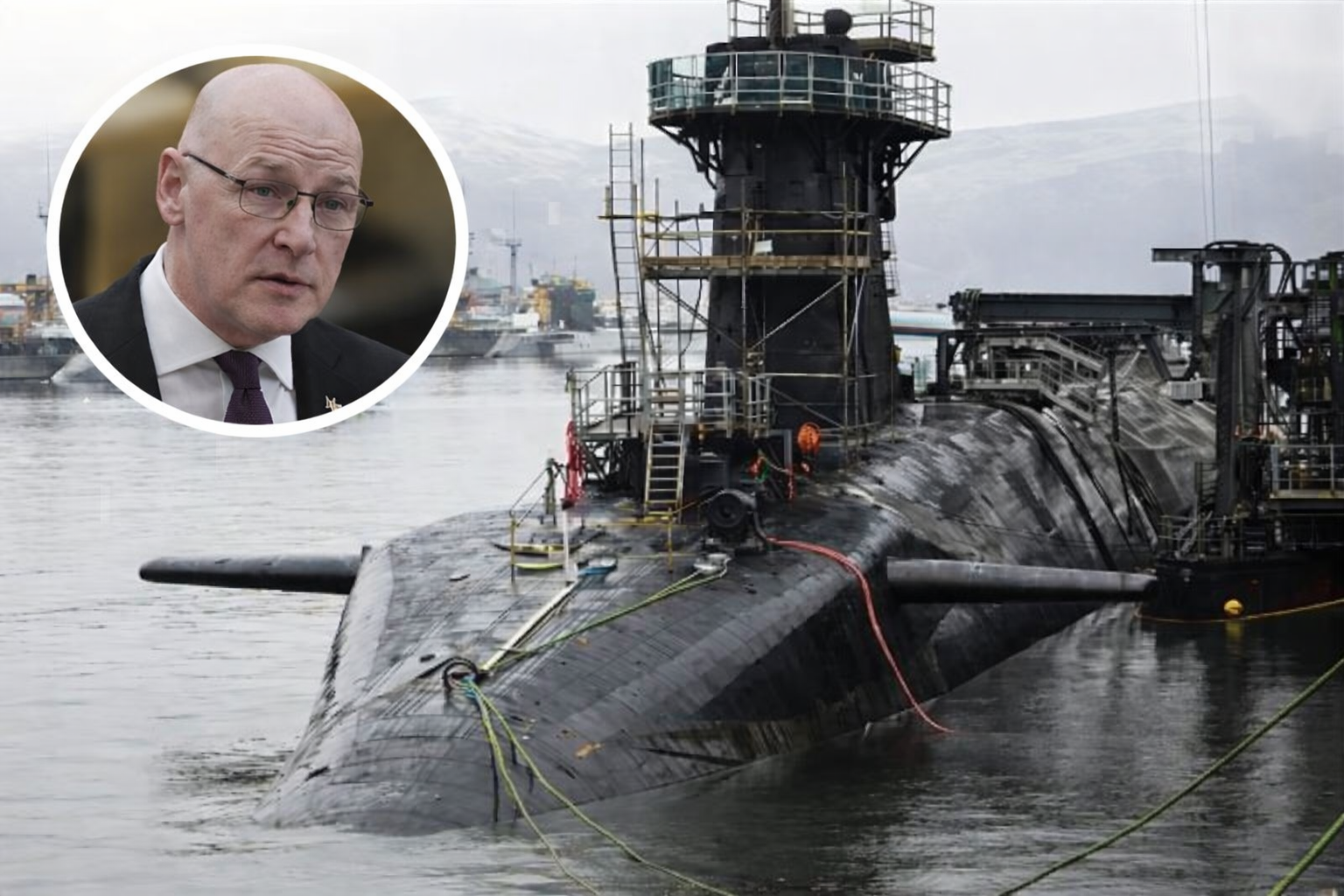
Campaigners have long stressed that the existence of Faslane and Coulport makes Scotland a key target for nuclear attack. While this is true, it is questionable whether it makes us significantly more vulnerable.
An attack on the Clyde bases using nuclear weapons would almost certainly form part of a general nuclear exchange. If that threshold were crossed, humanity would be plunged into a full-scale nuclear war likely to end civilisation as we know it within weeks. In that context, the more pressing concern is that these bases serve as launch pads for weapons of mass destruction.
NIMBY arguments simply do not work in this context, any more than so-called “national security” measures protect individuals on either side of man-made borders. Pandemics, nuclear power accidents and cyber terrorism all demonstrate the porousness of borders when facing existential threats.
Sack Faslane WMDs
Removing nuclear weapons from Scotland would be a major step forward. First, it would provide powerful encouragement to the global nuclear disarmament movement by dramatically bucking the current international trend and clearly demonstrating that nuclear capability lacks a democratic mandate. Second, it would effectively end the UK’s submarine-based nuclear arsenal, as the Clyde bases cannot feasibly be relocated elsewhere in the UK.
When it comes to nuclear weapons, the backyard is the entire world. Anyone in doubt should read Annie Jacobsen’s Nuclear War – A Scenario. On 27 January, the Bulletin of the Atomic Scientists moved its ‘Doomsday Clock’, a metaphor for humanity’s proximity to catastrophe, to 85 seconds to midnight, the closest it has ever been set.
This setting reflects a multidisciplinary assessment of the main existential threats facing humanity: climate collapse, disruptive technologies such as artificial intelligence, and nuclear war. For those who prefer film to text, House of Dynamite, currently streaming on Netflix, explores similar themes. There is nothing inevitable about these terrifying scenarios. We possess the knowledge, skills and resources necessary to address them. In the case of nuclear weapons, after initial steps of de-escalation and mutual arms control, real progress must be made towards complete elimination.
At the height of the Cold War, Reagan and Gorbachev embarked on a bilateral de-escalation process that temporarily saved humanity from disaster. Their original intention was to complete the job by eliminating nuclear weapons altogether. That final step was never taken.
The tool to finish that work exists today in the Treaty on the Prohibition of Nuclear Weapons. The treaty has been ratified by 74 UN states, with a further 25 having signed it, and around another 30 regularly supporting it when it appears on the agenda of the UN General Assembly.
This solid majority is drawn mainly from the Global South, with Ireland, Austria and Malta standing out as European exceptions. These regions are also those most affected by climate crises and climate-driven migration, and where the links between nuclear war and irreversible climate catastrophe are most clearly understood.
This understanding underpins the decision by the Atomic Scientists to move the Doomsday Clock to 85 seconds to midnight.
Nuclear weapons are a domestic issue
Scotland’s place, and its potential role, must therefore feature prominently in the run-up to May’s election. Nuclear weapons are a domestic issue.
A stance on nuclear weapons is a key marker for a whole interconnected set of concerns: long-term versus short-term thinking; human welfare; ecology and climate; education for peace; economic sanity; the right to life; global justice and equality; human security and rights; international humanitarian law; accountability for war crimes; realism and prudence; just transition; food and farming; physical and mental health; diversity and inclusion; violence reduction; international and community peace; creativity and the arts; our relationship with the natural world; ethics and morality; transport; cats and foxes; ocean health; peace in space, and much more besides.
It is bread and butter politics. It is the day-to-day. The UK government is regularly at odds with the views of Scottish voters, and given Scotland’s limited representation at Westminster, the Scottish government has a significant role in representing the country both domestically and internationally.
As May approaches, voters should choose their own red lines and set clear criteria for electing a government capable of representing Scotland as effectively as possible, whether or not it is pursuing self determination.
 Scottish Socialist Voice
Your site rejected my FACTUALLY CHECKED POST Do not email me in future if you are showing BIAS toward Factual Comments Good Bye Trevor Swistchew
LikeLike