
The Great War Xmas Truce, 1914: Not a miracle at Christmas, but a rebellion
by Natalie Reid, SSP Co-Spokesperson
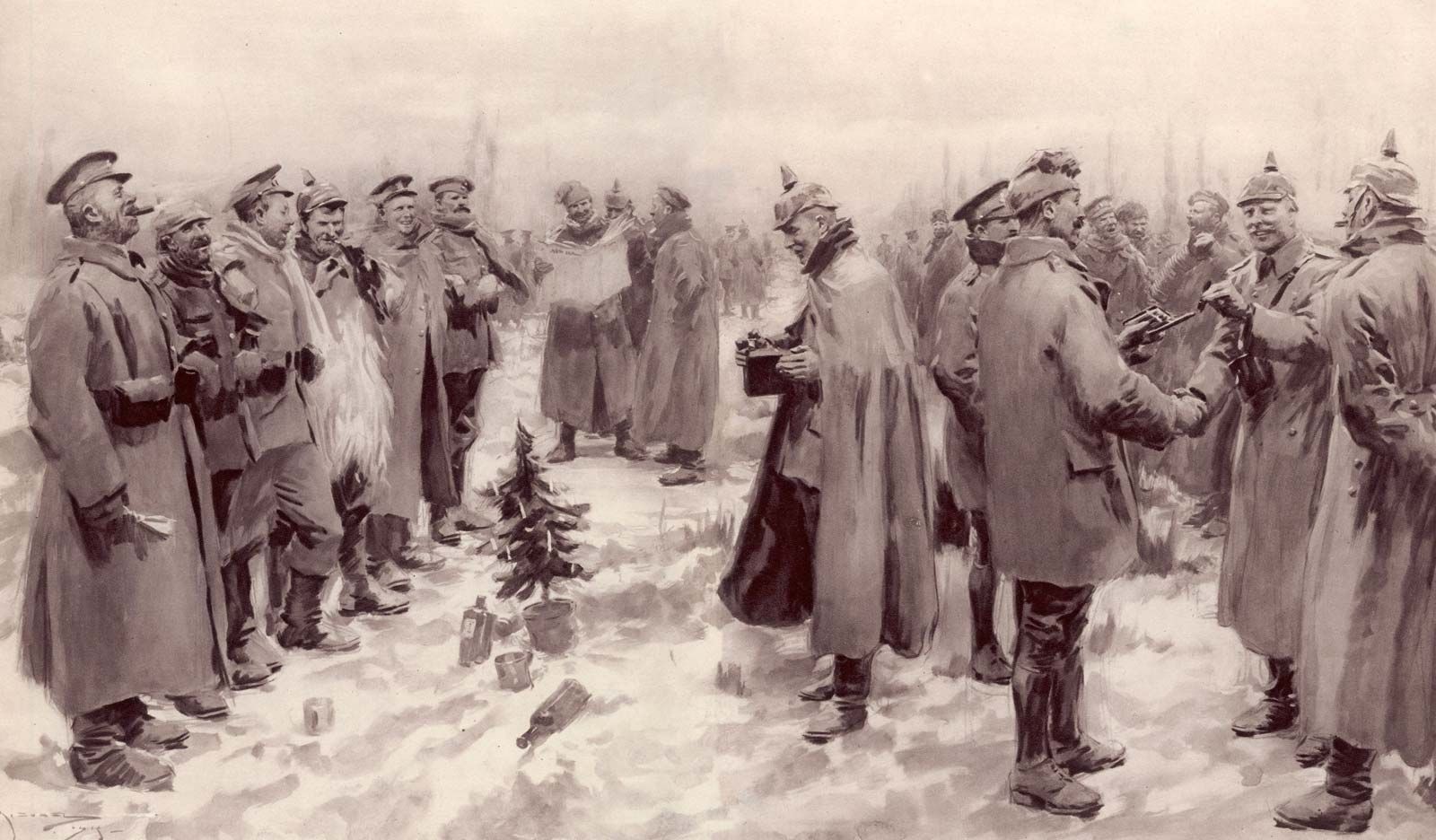
MOST OF US have heard the famous stories of the football matches played between British and German troops on Christmas Day in 1914. This forms part of a wider event, known as the Christmas Truce, that took place during the first Christmas of World War I.
Over 100,000 troops are said to have taken part, refusing to fight one another on Christmas Day. It started with the German troops singing Silent Night in German, English and French, lighting candles and decorating trees.
The British and French troops joined in with the singing, and soon the two sides started trading Christmas greetings with one another. This led troops on both sides to come out of the trenches (Germans first, by most accounts), exchanging gifts — mostly sought-after, rationed items like tobacco, chocolate and alcohol — and staging impromptu football matches. Both sides were also able to retrieve bodies from no man’s land.
The Christmas Truce covered almost the entirety of the Western Front (mainly German, French and British soldiers), as well as smaller areas of the Eastern Front between Russian and Austrian troops.
In some areas this truce lasted right up until the New Year. In others, just until Boxing Day.
This heart-warming story is often told at Christmas time in the UK, even over 100 years later. It’s rightly looked upon fondly as a show of camaraderie and human decency in a time of unimaginable violence and distress.
A beautiful lesson in how humans can seek out peace and friendship even in the darkest of times. What’s hardly ever mentioned is the fact that the British authorities strongly opposed the Christmas Truce, and sought to courtmartial those who had taken part.
“Peace on earth” was not on the agenda for the war-hungry imperialist powers. Make no mistake: the Christmas Truce was a mutiny — it was soldiers disobeying the order to kill.
World War 1 was famously supposed to be “the war to end all wars”. It was brutal, bloody trench warfare that left millions dead or horrifically injured. There was no idealistic battle to be fought — it was two imperialist power blocs fighting over land and wealth, using droves of the working class like pawns in a chess match.
Not surprisingly, this didn’t inspire the troops much, and the appetite for unnecessary slaughter had long been waning on both sides.
The truce was by no means the first or last mutiny during WWI. There are several documented occurrences, from both sides of the trenches, of soldiers refusing to engage in combat. Acts of everyday resistance were so common they had names — such as the “live and let live” principle, where both sides would purposely mortar or shoot at areas they knew to be unoccupied, or “search and ignore”, where troops sent out on missions to target the opposition would instead deliberately avoid them.
The Christmas Truce is presented to us as some kind of military badge of honour, when in reality it was a rebellion against the military. It was not their imperialist victory, but a victory of the international working class — a beautiful act of rebellion from both sides of the trenches.
The truce — or, to give it its true name, mutiny — was a moment of common humanity, where working people on both sides acknowledged their shared material conditions.
It was not a miracle: it was a human choice to stand up to power, to choose peace over war. The generals and war-makers were so shaken by this mutiny that the British authorities first sought to court-martial those involved. They soon decided that this would be disastrous PR, especially at Christmas, and also practically impossible given that over 100,000 soldiers took part.
But they still took measures to ensure it wouldn’t happen again, and harsher punishments were implemented for “fraternising with the enemy”. That was how much they feared the united working class. Their fears were correct — as, of course, WW1 ended with general strike and revolution in Germany and Russia.
Over a century has passed since the “war to end all wars” and yet peace is as elusive as ever. Wars may no longer be fought in trenches, but we still see thousands of deaths and casualties.
The military-industrial complex is a multi-billion-dollar industry that sows the seeds of division and discontent in the pursuit of power and profit. Peace will not be gifted to us by an imperialist power. Not on Christmas Day, or any other day. They have no interest in peace, and absolutely no qualms about sending soldiers to their deaths.
They use terms like “tragedy” to imply that war is somehow beyond control and inevitable, when in fact soldier or civilian death is acceptable collateral damage in their quest for power —whether the war is for land, resources or control. Peace must be sought by the people. We must demand it. Mutinies such as the Christmas Truce show a chink in the armour of the violent arm of capitalism. Their power is not absolute, and when we challenge them — soldier or civilian — we show them that we know they are not untouchable
 Scottish Socialist Voice
Leave a comment