Lecturers and other staff at the University of Edinburgh are beginning a further three days of strike action in a dispute over the university’s plans to make cuts of £140m. Here, we repost a piece from a recent subscription edition of Scottish Socialist Voice, on the crisis in higher education in Scotland…
by Richie Venton, SSP national workplace organiser
· Every branch of Scotland’s education system is in crisis. The consequences are savage job losses, increasingly including compulsory redundancies; cuts to courses; reduced contact time and pastoral care for students; worsened experiences for children and young people; and long-term damage to people’s personal development and the health of local economies.
There need be no such crisis given that we live in the 6th-richest economy on Planet Earth. However, over a decade of systematic government underfunding, and widespread mismanagement by grotesquely overpaid bosses in universities and colleges, has led to the alarm bells being rung — not only by staff trade unions, but also in the most recent report by the Scottish Funding Council (SFC).
Early years crisis The number of teachers in pre-school education has been decimated, with serious damage to the life prospects of small children at their most formative stage of education. Class sizes in Scotland’s schools are amongst the largest in all the OECD countries, with 33+ being commonplace.
Understaffing means teachers work the equivalent of 1.5 days per week extra, totally unpaid, every week of the school year. Whilst many qualified teachers are on precarious contracts, crying out for permanent posts, cutbacks mean they fail to get onto a secure career path, and in many cases abandon the profession. Meanwhile, permanent teachers suffer escalating levels of demoralization, stress and poor mental health from overwork. Children and young people suffer the consequences.
Cuts to ASN provision Studies show that about 40% of children and young people in mainstream classes have a recognised additional support need (ASN). But in the overwhelming majority of cases, cutbacks to ASN staffing means one teacher on their own encounters classes of at least 33; and this situation is a major driver of aggressive behaviour and increased violence in the classroom.
FE colleges ‘risk insolvency’ This week’s Scottish Funding Council report makes for alarming reading on the state of both Further Education colleges and universities. FE colleges rely on the SFC for 77% of their income, but government funding via the SFC has at best flatlined, whereas daily running costs soar.
The report shows 17 out of Scotland’s 24 FE colleges were already in deficit last year, and 22 of the 24 are forecast to spend more than their income by the end of this financial year. In the words of the SFC report, “there is an imminent risk of several colleges becoming insolvent.”
Principals wield the axe FE college principals, many of whom earn more than Scotland’s First Minister, are responding with cuts to teaching time and the courses available, plus increased class sizes, thereby worsening the quality of education on offer, in the sector that caters mostly for working-class people, ranging from apprentices and school-leavers to mature students.
Scottish Government funding — which, let’s not forget, accounts for 77% of the entire budget of these colleges — has been slashed by 17% in the past four years. It’s taken strike action by FE college lecturers and support staff in nine out of the past 10 years to defend professional standards, jobs, pay, and the quality of education from even more savage destruction.
University funding slashed The crisis in Scotland’s universities is just as severe, if not more so. Eleven out of Scotland’s 18 universities are expected to spend more than their income this year, with a total deficit of £12.9m.
Scottish Government funding to this sector has fallen by 20% over six years. And according to the employers’ umbrella body, Universities Scotland, funding per student has plummeted by 39% in real terms over the past decade.
Even within that litany of austerity, newer universities like Glasgow Caledonian and University of the West of Scotland (UWS) have been particularly badly clobbered by funding cutbacks. This despite — or some might even think, because of — them having a much higher than average proportion of students from working-class backgrounds.
Over-reliance on overseas student fees Instead of waging a battle for an entirely different funding model, based on progressive taxation of wealth and public investment in publicly owned and controlled universities, those in charge have increasingly turned to reliance on overseas students for university incomes. The number of overseas students at Scottish universities nearly doubled from 24,000 in 2006/7 to a peak of 47,700 in 2022/23.
We shouldn’t forget that students from outside the UK are charged at least £30,000-a-year in fees. And in the case of the University of Glasgow, a report a year ago showed that 82% of that institution’s entire income came from overseas students. Alongside that, private companies are raking in an absolute fortune from exorbitant rents of at least £800-a-month for a single room in the ubiquitous student halls of residence.
Privatised, rip-off student rents As massive blocks — mini villages — of these sources of eye-watering profits for privatised landlords were thrown up on every available blade of grass in parts of Glasgow, I remember warning years ago “What will happen when the Chinese government have upskilled their own universities, in part by sending students abroad, and stop this flow of students to Scotland with the accompanying fees and stacks of rent they pay?” That process has now begun to kick in. There was a 16% fall in the number of international students last year.
Reactionary immigration policies from the Labour government -and the hostile atmosphere incited by mainstream politicians in their attempt to outstrip the racism of Nigel Farage — have reinforced the trends towards countries like China (still the biggest source of all the overseas students in Scotland) increasingly taking in students at home rather than sending them abroad.
This week’s Scottish Funding Council (SFC) report warns of the dangers — somewhat belatedly — of over-reliance on international students, as this gargantuan source of income begins to dry up. Prior to these alarming SFC revelations, an open letter from NUS Scotland and the trade unions in the sector warned the Scottish Government last May that education is “teetering on the edge of collapse.”
The choices we face So what to do about it? The answer from principals, vice-chancellors and other university bosses on salaries which defy the human imagination is to slash jobs, cut courses, freeze recruitment, pause promotions, and then offer university staff a derisory 1.4% pay ‘rise’ which in real life is a pay cut of at least 3%.
To illustrate the point, Edinburgh University recently shed over 350 staff through voluntary redundancies, thereby cutting £24m from their budget. Sir Peter Mathieson, principal of Edinburgh University, has announced they need to save £140million, and recently ushered in a further batch of voluntary redundancies, enhanced retirement schemes… but not ruled out compulsory redundancies. He himself is on a salary of £420,000.
At Dundee University, where up to 700 jobs were at risk, strike action threw back some of that butchery, and the Scottish government were forced into a £40million bailout despite a review by the same government finding that the university had “failed to meet governance standards.”
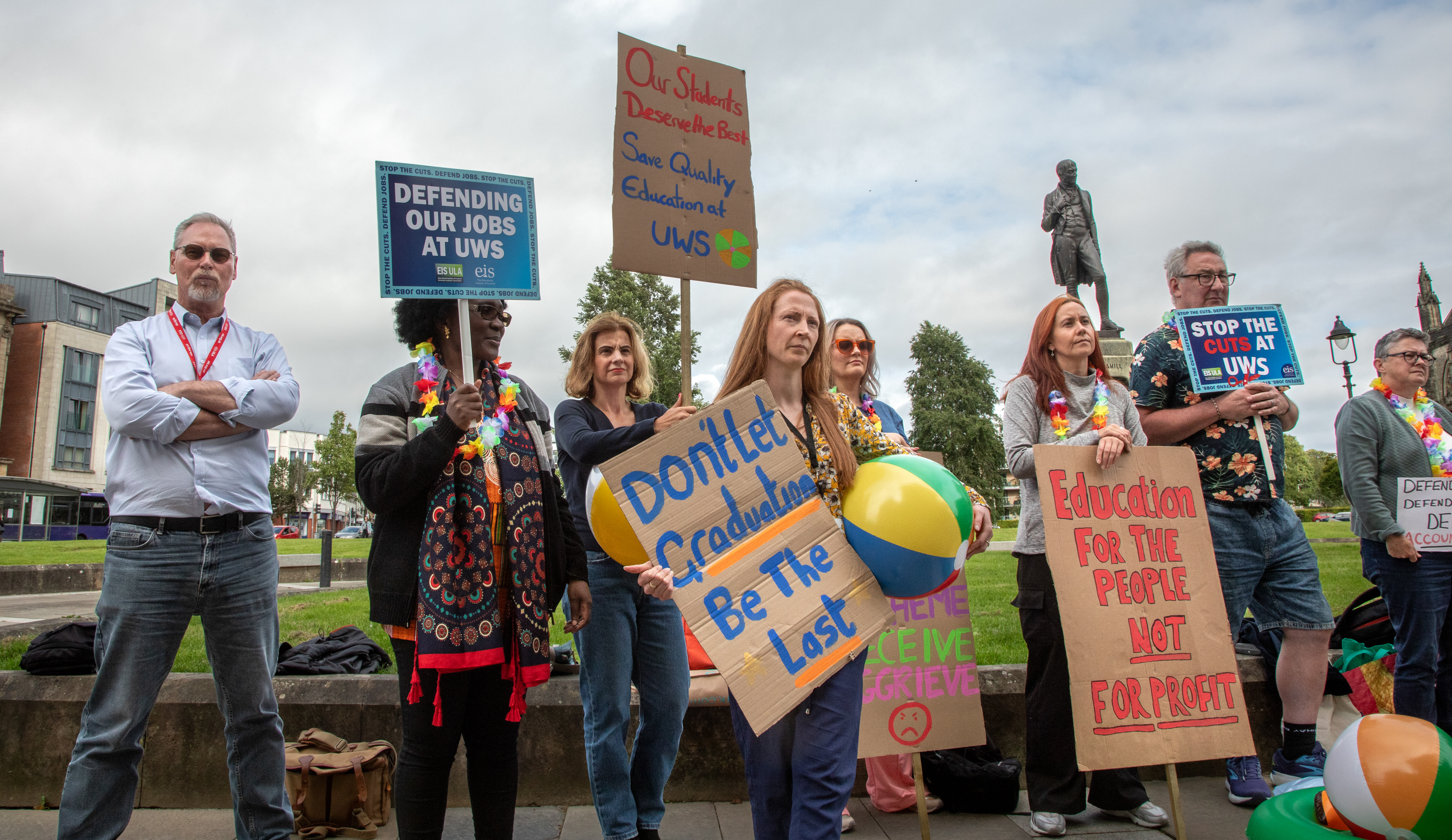
UWS strike against redundancies At the University of the West of Scotland (UWS), where EIS members are currently staging rolling strike action, 75 full-time equivalent jobs are threatened by compulsory redundancy. The principal welding this axe is himself on a salary of £280,000, plus £40,000 expenses which he grabbed as he tours the globe.
His trips include London, New York and Barbados, in search of increased personal status and an enhanced CV when he no doubt moves on to pastures new, after ripping apart the fabric of a university famed for having over 30% of its students from deprived backgrounds.
His justification for his trips wears thin; he may wish to follow Typically Tropical’s old song “I’m going to Barbados”, but this publicly funded expedition has resulted in a grand total of one Barbadian student at UWS!
Socialist solutions Real solutions need to start with the recognition that education — at all its levels, from pre-school through to college and university — is a vitally important contribution to any civilised society; the development of human beings; and progress in the pursuit of a clean, green economy where people live in harmony and cooperation, with the elimination of poverty, inequality, exploitation, racism and wars. That requires a root-and-branch overhaul of the whole system, education included.
Public funding, ownership and control Instead of reliance on the whims of the market, a properly planned education system would require a wealth tax on millionaires, progressive taxation of the rich and big corporations, elimination of the profit motive — whether in research or student accommodation — and fully adequate funding by the government.
Cut class sizes, not jobs and courses Instead of the people of Scotland forking out £1.5million-a-day, every day for the next 30 years, on renewal of Trident weapons of mass annihilation, imagine the impact of those sums (£16billion from Scotland as a share of the £205billion total squandered on Trident nuclear weapons) if invested instead in fully-staffed playgroups, nurseries, primaries, secondaries, colleges and universities?
Class sizes in all levels of education need to be drastically cut, to accommodate individual attention from teachers and additional support need staff. Twenty’s plenty in a mainstream school class, let alone much smaller classes and individual support where there are additional support needs.
That would require investment in vastly more educators and support staff in our schools, colleges and universities, with decent wages and the job fulfilment that would go with much smaller class sizes.
A living student grant at 16 To make post-16 education genuinely free requires not just resistance to the growing clamour for the introduction of tuition fees for Scottish students from some capitalist quarters, but also introduction of a living student grant for everyone from the age of 16.
A student grant based on a £15-an-hour statutory minimum wage would mean people from working-class families don’t have to abandon their desire for further and higher education in favour of taking low-paid, precarious and often unfulfilling jobs just to survive. It will allow people to go into education later in life if they choose to, without bankrupting themselves and their family.
In tandem with that, an emergency plan to construct 100,000 eco-friendly council homes should include accommodation specially designed for students, integrated in the community, on affordable rents. That would combat student poverty and create thousands of skilled apprenticeships and jobs in the construction industry — boosting the demand for courses in trades and environmental sciences at FE colleges and universities into the bargain.
Sack the boards! Democratise education The Scottish government seems intent on behaving like Pontius Pilate, washing their hands of any responsibility for the gross mismanagement on display in many institutions, currently run like personal fiefdoms by grotesquely overpaid and unaccountable university and college principals.
Universities and FE colleges rely on the government directly for 24% and 77% of their entire budgets, respectively. Public funding demands public control, including government intervention against bad governance by currently unaccountable principals and their tame boards of senior management.
These places should instead be publicly owned, funded and democratised, with elected boards of management representing all grades of staff, students, local communities and the government; paid skilled wages and not the mind-boggling salaries currently guzzled by principals and vice-chancellors. Education should be a human right, not the source of rent, interest and profit that it is right now.
‘Why we are striking at UWS’
During the ongoing strike by EIS-ULA members at UWS (University of the West of Scotland), the SSP’s Richie Venton spoke to Katie Clark, EIS-ULA branch secretary at the university
Katie Clark: UWS EIS-ULA branch secretary
Why are you and your members on strike, Katie? We’re on strike because we’ve asked the university for a no compulsory redundancy guarantee, and this comes on the back of an Organisational Change Project where the university are suggesting they’ll have to cut 75.2 full-time-equivalent jobs due to financial pressures; but we would dispute that.
Did they offer voluntary redundancies? They opened a voluntary severance scheme, but they rewrote the terms so that it’s less lucrative terms, less attractive terms, and it’s very targeted, so it’s not open to everyone. So we are waiting to see the outcome of that and in the meantime we are still asking for a no compulsory redundancy guarantee.
What impact would that have on staff and the wider community? Well, it’s going to have a huge impact. 75 full-time equivalent redundancies in headcount is going to be a lot more than that. We’re talking about academics who are going to be leaving the university in really high numbers. That’s going to have an impact on them and their families. UWS has five campuses in five different locations. That’s five different communities that are going to be hit when there’s less income round the university.
And then thinking about our students as well; we’ve just been awarded the top university in the UK for social inclusion. That doesn’t happen by policy, that happens by lecturers working with students, students who require that extra time, that personal touch with their education. Less lecturers mean they won’t be able to give students that attention, which is really sad because it will have such a negative impact on their education and their outcomes.
Is there any justification for these savage cuts? No. The university has published its financial statements showing they have reserves.
What’s your wider appeal to other trade unionists and the public? My wider appeal is to come out, support us, speak to your local MSPs, let the university know you don’t agree with this, that you’re not behind it. Ultimately education is a right, and when there’s less educated people it has an impact on society for the longer term.
It’s not just about what’s happening now, it’s about the future as well as our society, our communities, our friends, our family, our kids. So please come down, get behind us, make some noise, make your opinion known that you don’t want any compulsory redundancies at UWS.”



 Scottish Socialist Voice
Leave a comment