
Miners’ strike book is a lesson in class war
'Class War on Workers' reviewed

• Class War on Workers: the great miners’ strike 1984-85 and its aftermath by Richie Venton. A Scottish Socialist Party publication, available here
If we know our yesterdays, we can shape our tomorrows
Book Review by Jamie O’Rourke, University of Glasgow SSP Society
In the first pages of his new book, Class War on Workers, Richie Venton tells us that several young comrades have confided in him that they know remarkably little about the Miners’ Strike.
Whilst I can’t say that this momentous anniversary has been my first exposure to the momentous moment in working class history, I am among those comrades who are too young to have any memory of the events of 1984 and 85.
Several SSP events — from an evening in Rutherglen featuring ex-miner Alan Ramsey, to the recent Jim McVicar Memorial Lecture fronted by Alex Shanks, also a former striking miner — have helped to remedy my relative lack of knowledge, but this book has proven perhaps the most valuable tool yet in studying, knowing, and learning about the strike.
The prose here is readable and engaging, the sections digestible, and the subject is handled with rigorous research and righteous anger. This is not a detached academic treatment of the Miners’ Strike: it is an involved, intelligent, and often infuriating book which serves to spur the reader on to take action.
‘Those too young to have witnessed…’
Throughout the book, we come face to face with the violence and brutality of the British ruling class. The assault on the miners claimed the lives of several miners at the time, with many more trade unionists reportedly taking their own lives in the aftermath of the strike.
The book details how Thatcher viewed the Miners’ Strike as her “Industrial Falklands”, a war this time not against Argentina, but against the working class of the United Kingdom which could be swiftly won, and which would boost her falling popularity ratings.
Indeed, Thatcher’s war on workers — as Venton explains — left the striking miners and their families starving, poor, and struggling to exist. The miners were battered by police thugs on the picket line, demonised on the television, and abandoned by many sections of the trade union movement.
Younger working-class people have witnessed the callous nature of our system, but we perhaps haven’t seen the capitalist machine at its most actively barbaric, with the velvet glove removed and the iron fist shamelessly brandished against workers. In this regard, the book is always eye opening and often shocking.
As well as this though, the book is instructive: if we are to build a better system, then we can expect the methods used against the miners to be used against our class as a whole. Through study of this pivotal moment in British working-class history, we can better learn how to fight back against the thuggish, undemocratic tactics which the ruling class will happily employ.
Scabs: ‘Those people let us down’
“When a scab comes down the street, men turn their backs and angels weep in heaven, and the devil shuts the gates of Hell to keep him out.” So Jack London wrote in his 1904 piece, ‘Ode to a Scab’.
Whether or not god and the devil have anything to do with it, many of the men and women who participated in and supported the 84-85 Miners’ Strike (and indeed in strike action before and after) regard scabs as the most despicable players in the war between the classes.
Those who acted out of naked self-interest and betrayed their comrades by crossing the picket are still seen as class traitors, totally devoid of loyalty or courage.
In a recent BBC News piece (‘Hard to forgive strike breakers, say ex-miners’), ex-striking miner Ronnie Peterson says, “The scabs…no, never, ever spoke to them, never ever, and never, ever will.” Heather Wood sums it up succinctly: “Those people let us down.”
Class War on Workers leaves us in no doubt as to the role of the scab in undermining the strike. As you read, you will feel the betrayal, the anger, and the disgust that the miners felt for those who scabbed on them. The lowest of the low, indeed! Backbones made of jelly and glue, indeed!
Lessons worth learning
In the first section of the book, Venton draws links between the Miners’ Strike and the Grangemouth dispute. This section — which discusses the need for a Socialist Green New Deal to fight climate change without sacrificing workings on the altar of green capitalism — builds on points which were discussed in more depth in Venton’s previous book (with Ken Ferguson) Socialist Change, Not Climate Change, an excellent companion piece to this volume.
Later in the book, we see the Quisling Labour leadership of (now Lord) Neil Kinnock selling workers down the river with his betrayal of the striking miners, and half-hearted words of solidarity paired with regular condemnation of the tactics and methods of the NUM.
The similarities between this right-wing Labour leadership and today’s even further right regime of Sir Kier Starmer (who, unlike Kinnock, does not even pretend to be a friend of the working class) are clear, and the Labour Party’s betrayal of the working class during this dispute seems like an ominous portent of things to come.
This is perhaps the book’s strongest quality, and the thing that makes it so valuable as a resource. The drawing of links from the events of the 1980s to the political landscape of today help to illuminate our own struggles. The lessons of the Miners’ Strike are as important now as they were in the immediate aftermath of the dispute, if not more so.
Know your yesterdays
The defeat of the Miners’ Strike was a massive blow to the working class of this country, and a big boost for the capitalists. Venton shows that an analysis of this dispute, and an awareness of just how close the strike came to overthrowing Thatcher’s Government, makes it crystal clear that a socialist future is eminently achievable.
The strike also revealed the true nature of the Labour Party. As Lenin said “It is at moments of need that one learns who one’s friends are. Defeated armies learn their lesson.” This lesson is more pertinent than ever now.
If we are to learn from the successes and failures of our past, we must know our history. For any young socialist in the UK who wants to become better acquainted with this remarkably important period in working class history, this book is a must read.
If we know our yesterdays, we will be better placed to shape our tomorrow. Class War on Workers is a welcome addition to the field of British socialist history and required reading for any young socialist in Scotland today.
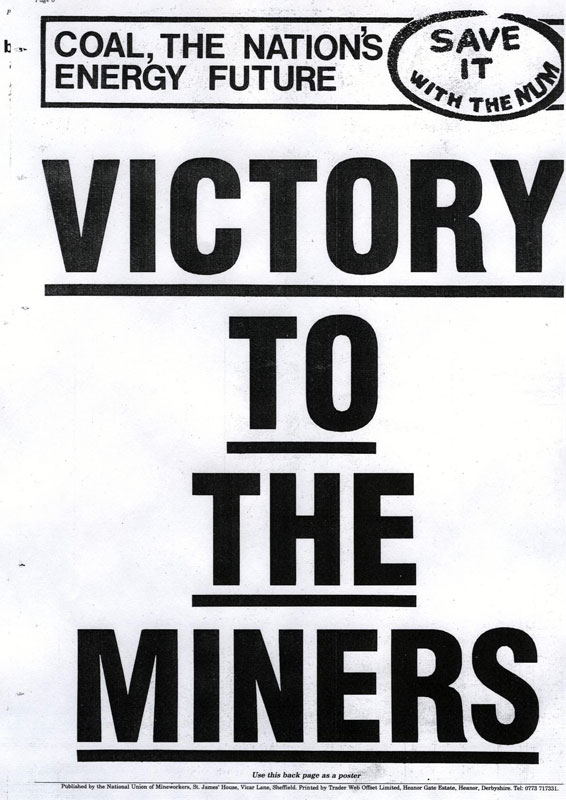
Forty years on, pro-capitalist forces within the labour movement still need to be defeated
by Ken Ferguson, editor, Scottish Socialist Voice
• Richie Venton is one of the most prolific and sustained writers on the Left today with a library of publications on topics ranging from socialist solutions to the climate crisis to the impact of the October revolution of 1917 to his credit.
In this his latest publication Richie offers us a detailed account of the origins of the Tories class war planning that led to the strike, tears aside the mask of “democracy” revealing the police brutality unleashed on miners and the heroic wave of solidarity with which working class people responded.
For those of us who lived through that tumultuous year either directly in the coalfields or, as in my case, working on practical solidarity collecting food, nappies, winter clothes the book brings , flooding back, memories both heroic and sombre.
However for the many who have at best heard of the Great Strike or read of it this book has a wealth of information and, perhaps most importantly, contains much that is relevant to our current crisis ridden world.
Key lesson
To me, the key lesson is that, behind the facade of apparently quaint “honourable gentlemen,” black rod and benches two sword lengths apart stand an ultra modern, fully equipped repressive machinery of anti-democratic laws, police power and, ultimately, jails.
Anyone still taken in by the guff about the UK as the oldest democracy needs to look at the repressive laws and the savage sentences doled out to peaceful climate protestors and relentless propaganda pumped out at those opposing the Gaza genocide.
Finally for any serious socialist perhaps the most immediate issue need to be the cowardly refusal by Labour figures such as Neil Kinnock and their right wing union allies to build the material solidarity with, which as Richie shows, could have delivered victory to the miners.
The politics which underpinned that cowardice is plain to see today with a supposed “Labour” government refusing to end child poverty, freezing pensioners and robbing billions from the world’s poorest to buy arms.
Forty years may have passed but those same essentially pro-capitalist forces within the labour movement are still in place and need to be defeated.
Subscribe now to receive the regular Voice newspaper PDF
https://scottishsocialistvoice.wordpress.com/subscriptions/
 Scottish Socialist Voice
Leave a comment